Return of the Wolf by Paula Wild
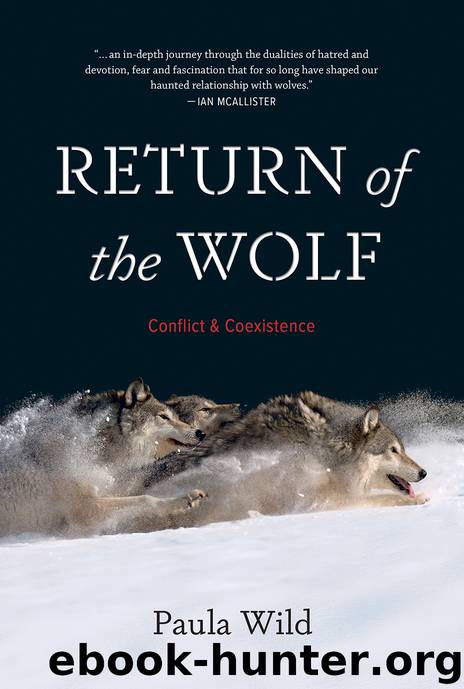
Author:Paula Wild
Language: eng
Format: epub
Tags: Human-animal encounters, Wolves, Ecology, Human-animal interactions, Animals, Wild Animals
ISBN: 9781771622073
Publisher: Douglas and McIntyre (2013) Ltd.
Published: 2018-10-12T16:00:00+00:00
This photo of a wolf carrying the hindquarters of a caribou was taken in Alaska’s Denali National Park and Preserve. Caribou and reindeer populations worldwide are declining due to climate change and human-caused fragmentation of their habitat. Photo courtesy of the US National Park Service
Like most wildlife, caribou lead a precarious existence. Finding food, birthing and caring for young, enduring extreme weather conditions and evading predators and disease are all part of life. Their populations can fluctuate dramatically under natural conditions. In more recent times, woodland caribou have experienced the added stress of dramatic alterations to the landscape due to climate change, logging, mining and the oil and gas industry, plus recreational development and activities. Their habitat is crisscrossed with roads, as well as seismic and power lines; the stillness is shattered by snowmobiles, trucks and equipment. In some areas these changes have made caribou habitat more welcoming to moose, and wolves have followed.
A creation story of the Inuit describes how the first people feasted on caribou but because they killed only large, strong animals, the herds became vulnerable. So the wolf was created to feed on the weak and old. But now the ratio of wolves to caribou in some places is greater than it was in the past, adding another challenge to the ungulates’ survival.
Globally, caribou are listed as vulnerable by the International Union for Conservation of Nature (IUCN), with populations decreasing. Caribou in BC and Alberta are currently classed as endangered by the Committee on the Status of Endangered Wildlife in Canada (COSEWIC). That means provinces are mandated to improve the situation by the federal government. Dwindling caribou herds have been a problem in Canada since the 1940s. In recent years, BC and Alberta have tried a variety of initiatives to reverse the decline. Moratoriums have been placed on new tenures and development for commercial winter recreation and resource industries. Some habitat has been protected—in April 2018, the BC government pledged $2 million to fund caribou habitat restoration—and some areas have been closed to snowmobile use. Six years ago, BC spent about $10,000 per animal to transplant 20 caribou from northern BC to the Kootenays in the southeast in an effort to bolster the 14-member Purcell herd. One of the caribou died and, due to weather, the rest were dropped some distance from the herd they were supposed to join, with most ending up in Montana or Washington state. Trial or “passive adaptive management” experiments have involved sterilizing wolves, increased hunting to reduce moose populations, supplemental feeding of caribou, and maternal denning pens, where cow caribou and their newborn calves are protected and fed for a period of time.
In BC, a five-year test wolf cull was launched province-wide in the winter of 2014–15. At that time, the South Selkirk caribou herd in southeastern BC had plummeted to 14. By 2018, at least 24 wolves had been culled from the area and it was believed that only 3 caribou remained. Within the same time span, more than 300 wolves had been culled in the South Peace region of northern BC.
Download
This site does not store any files on its server. We only index and link to content provided by other sites. Please contact the content providers to delete copyright contents if any and email us, we'll remove relevant links or contents immediately.
Whiskies Galore by Ian Buxton(42168)
Introduction to Aircraft Design (Cambridge Aerospace Series) by John P. Fielding(33249)
Rewire Your Anxious Brain by Catherine M. Pittman(18799)
Craft Beer for the Homebrewer by Michael Agnew(18346)
Cat's cradle by Kurt Vonnegut(15558)
Sapiens: A Brief History of Humankind by Yuval Noah Harari(14557)
Leonardo da Vinci by Walter Isaacson(13522)
The Tidewater Tales by John Barth(12755)
Thinking, Fast and Slow by Kahneman Daniel(12536)
Underground: A Human History of the Worlds Beneath Our Feet by Will Hunt(12236)
The Radium Girls by Kate Moore(12186)
The Art of Thinking Clearly by Rolf Dobelli(10720)
Mindhunter: Inside the FBI's Elite Serial Crime Unit by John E. Douglas & Mark Olshaker(9530)
A Journey Through Charms and Defence Against the Dark Arts (Harry Potter: A Journey Throughâ¦) by Pottermore Publishing(9340)
Tools of Titans by Timothy Ferriss(8598)
Wonder by R. J. Palacio(8245)
Turbulence by E. J. Noyes(8217)
Change Your Questions, Change Your Life by Marilee Adams(7938)
Nudge - Improving Decisions about Health, Wealth, and Happiness by Thaler Sunstein(7862)
